Report · Digital edition
The Secondary Effects of Climate Change
Cascading Shocks from Extreme Weather to Food Insecurity, Educational Disruption, Migration, and Political Instability
Abstract
Most climate assessments focus predominantly on direct physical impacts: flooded infrastructure, destroyed homes, and acute storm mortality. However, empirical analysis across vulnerable regions reveals that direct damages represent merely the tip of the climate iceberg. The vast majority—estimated at over 85% of total societal welfare loss—operates through secondary and tertiary cascade channels. An acute drought or flood rapidly propagates through agricultural contraction, global agflation, and severe household budget destruction. In low-income economies, this triggers acute maternal and child malnutrition, irreversible cognitive stunting, and the forced withdrawal of children from formal education to engage in informal labor. As agricultural livelihoods collapse, rural communities face distress migration into overburdened urban centers or cross-border corridors, amplifying resource friction, governance breakdown, and civil instability. This report quantifies these hidden indirect harms, traces their transmission dynamics, and provides a structural framework for resilience.
- 5
- Chapters
- 5
- Exhibits
- 1
- Data tables
- 15
- References
Key insights
- Direct climate damages (infrastructure loss and storm fatalities) account for only ~12% of total societal welfare loss; indirect secondary cascades drive ~88% of human and economic harm.
- Extreme heat and water deficits contract staple crop yields, driving sharp food price inflation (agflation) that devastates the poorest households who spend 60%+ of their income on food.
- Climate-induced nutritional shocks during pregnancy and early childhood cause irreversible stunting, slashing lifelong adult earning capacity by over 20%.
- Educational disruption acts as a primary negative coping mechanism: households facing climate income shocks pull children from school, reducing national GDP growth for generations.
- The World Bank projects 216 million internal climate migrants by 2050, overwhelming urban sanitation and municipal infrastructure in developing megacities.
- Climate acts as an institutional threat multiplier, accelerating farmer-herder conflicts, anti-austerity protests, and political instability in fragile states.
Chapter 1: The Cascading Iceberg: Beyond Direct Climate Damages
Public discussions of climate change almost universally center on direct physical impacts: satellite images of Category 5 typhoons, aerial photography of flooded bridges, blackened acreage from wildfire conflagrations, and official tallies of drowned or heat-struck casualties. While devastating, these tangible physical damages represent merely the visible tip of a much deeper, more destructive iceberg.
In reality, direct damages account for approximately 12% of total societal welfare loss caused by climate volatility. The remaining 88% operates through a series of secondary and tertiary systemic cascades—diffuse, delayed socio-economic shocks that radiate outward across globalized supply chains, national labor markets, human capital development, and political institutions.
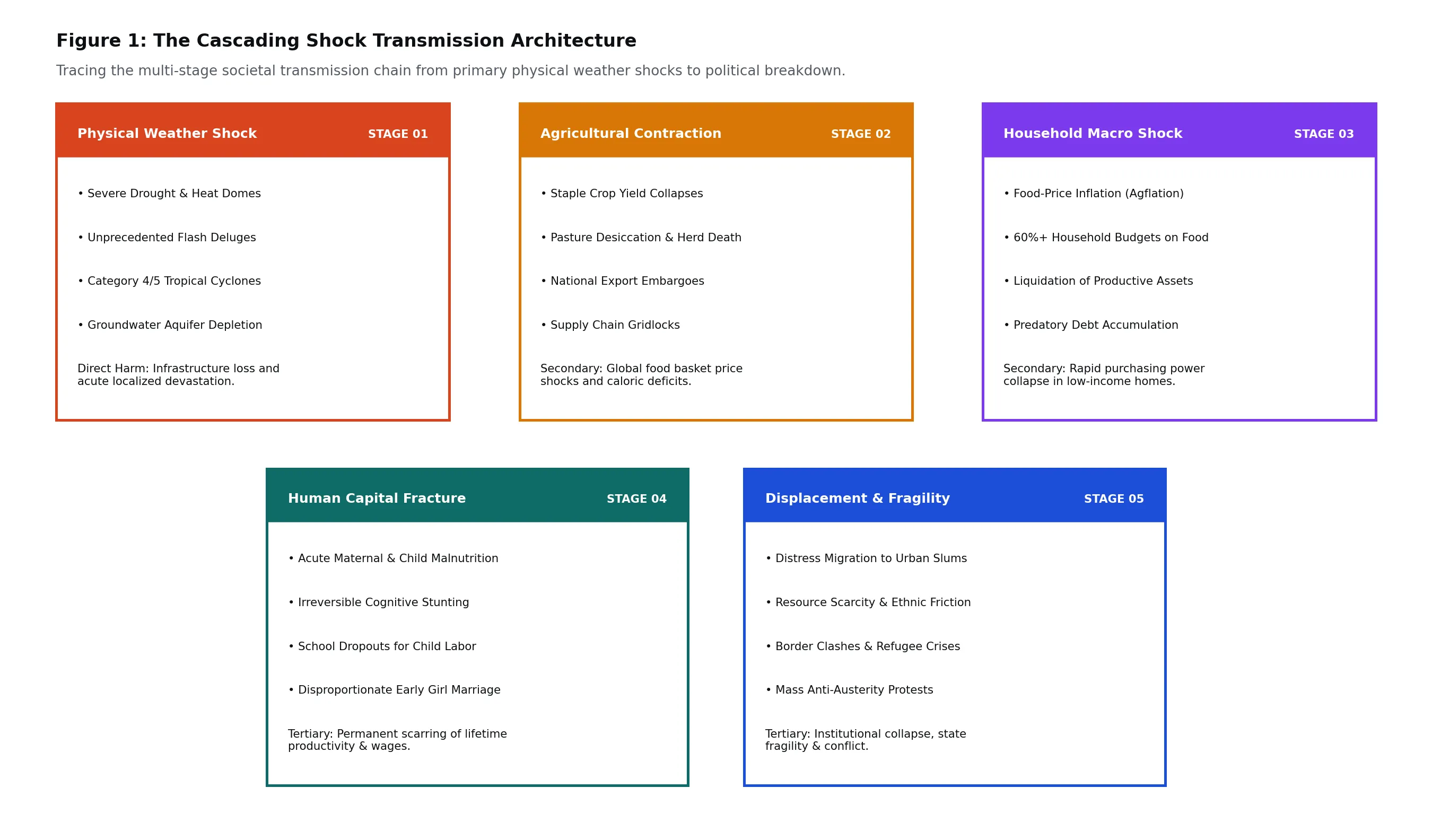
When an unprecedented heat dome or multi-year drought strikes a breadbasket region, the immediate physical damage to farm equipment or local roads is negligible. The catastrophic damage occurs as the shock cascades:
- Harvest Contraction: Critical crop yields collapse, drying up regional food supplies.
- Food Price Inflation (Agflation): Commodity markets experience sharp supply deficits, sending staple food prices soaring.
- Purchasing Power Destruction: In developing nations where families allocate over 60% of their daily income to food, price spikes obliterate household balance sheets.
- Human Capital Erosion: Families skip meals, children suffer irreversible physical stunting, and teenagers are withdrawn from school to work in informal labor markets.
- Societal Destabilization: Distressed rural communities migrate into crowded urban slums, overburdening municipal services and igniting civil unrest.
Understanding climate change requires moving past simple asset-loss accounting and tracing how environmental trauma mutates into long-term human and political fragility.
While an extreme weather disaster unfolds over hours or days, its secondary effects—such as cognitive stunting from childhood malnutrition and lost lifetime productivity from discontinued schooling—depress human development and economic growth across a 40-year intergenerational horizon.
Chapter 2: The Agricultural Transmission: Crop Deficits, Agflation, and Household Ruin
Agriculture is the primary transmission belt through which physical climate shocks enter the global economy. Unlike manufacturing or digital services, crop production is strictly bound by biological and thermodynamic boundaries: nighttime heat thresholds, pollinator synchronization, topsoil moisture retention, and chilling hours.
When ambient temperatures exceed 30°C to 35°C during critical flowering and grain-filling windows, staple crops such as maize, wheat, rice, and soybeans experience thermal sterility. Furthermore, compounding atmospheric Vapor Pressure Deficits (VPD) pull moisture out of plants faster than root systems can absorb it from drying soils.
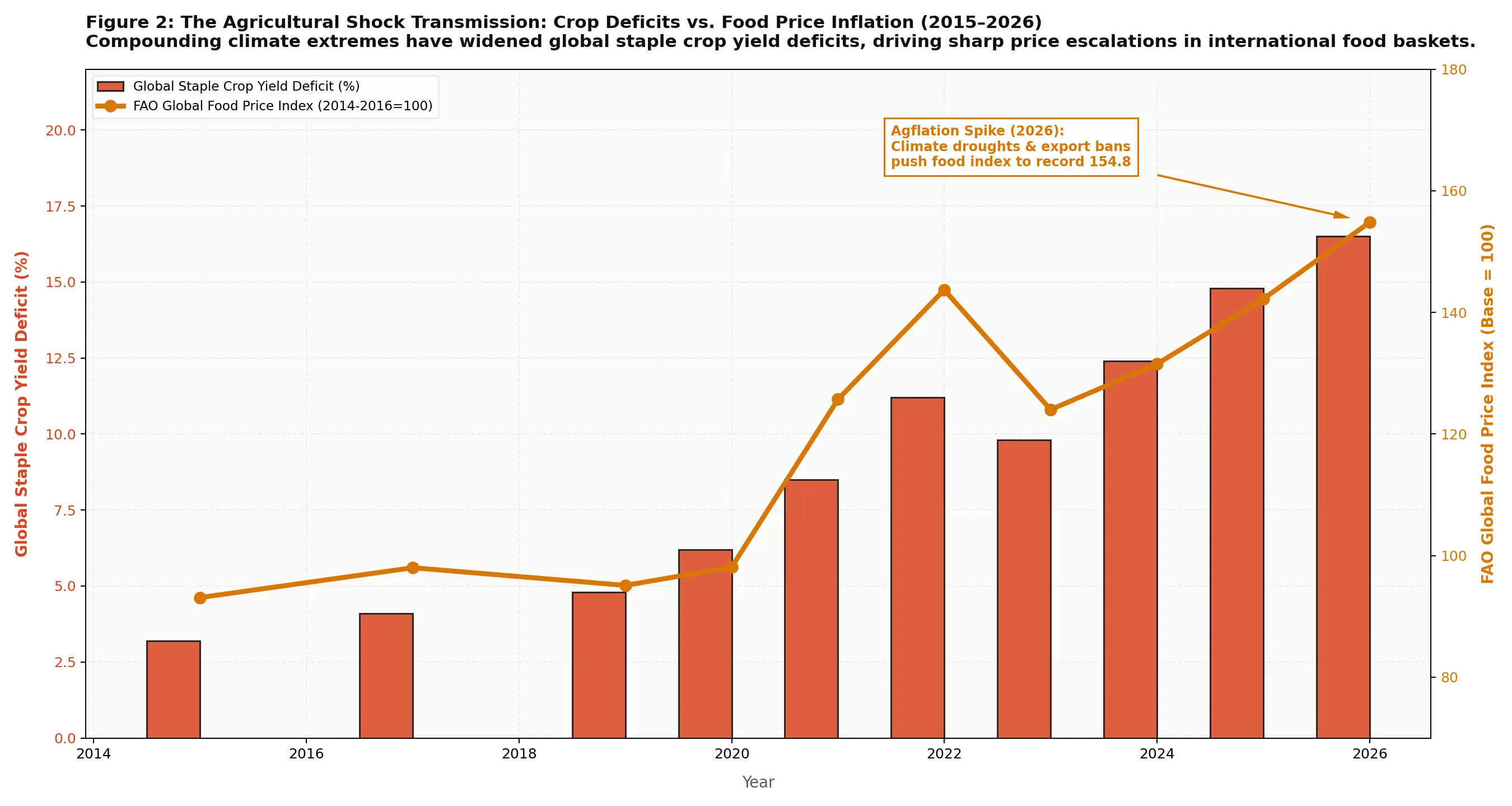
The macroeconomic transmission mechanism operates through three distinct pressure points:
- Inelastic Demand & Export Restrictions: Because calories are non-negotiable for human survival, agricultural demand is highly price-inelastic. When global yields fall by even 5% to 8%, market prices do not rise by 8%—they often spike by 40% to 60%. Fearing domestic food riots, major grain-exporting nations frequently impose emergency export embargoes (as seen with wheat, rice, and sugar in recent years), choking international liquidity and sending import-dependent nations into fiscal crises.
- The Asymmetric Burden on the Global South: In high-income OECD economies, food represents only 8% to 14% of typical household expenditure. In low- and lower-middle-income countries across Sub-Saharan Africa, South Asia, and Latin America, food accounts for 50% to 75% of household budgets. A 30% surge in cereal prices forces immediate cutbacks in healthcare, fuel, and education.
- Asset Liquidation & Predatory Indebtedness: When consecutive droughts destroy harvests, subsistence farmers first deplete grain reserves, then sell productive assets (draft animals, tillers, maternal jewelry) at fire-sale prices, and finally borrow from predatory informal moneylenders at extortionate interest rates. Once these productive assets are gone, families are stripped of their ability to rebound when good rains return, falling into permanent poverty traps.
Chapter 3: The Human Capital Fracture: Childhood Stunting and Stolen Schooling
The most severe, long-lasting secondary consequence of climate change is the destruction of human capital. Economists and public health epidemiologists refer to this as the human capital fracture: the permanent degradation of a population’s physiological and cognitive capabilities caused by climate-induced economic distress.
When household budgets collapse during agricultural crises, parents adopt severe dietary coping mechanisms. Families cut animal proteins, fruits, and vegetables, subsisting exclusively on cheap, nutrient-poor starches, or reduce food intake to a single meager meal per day.
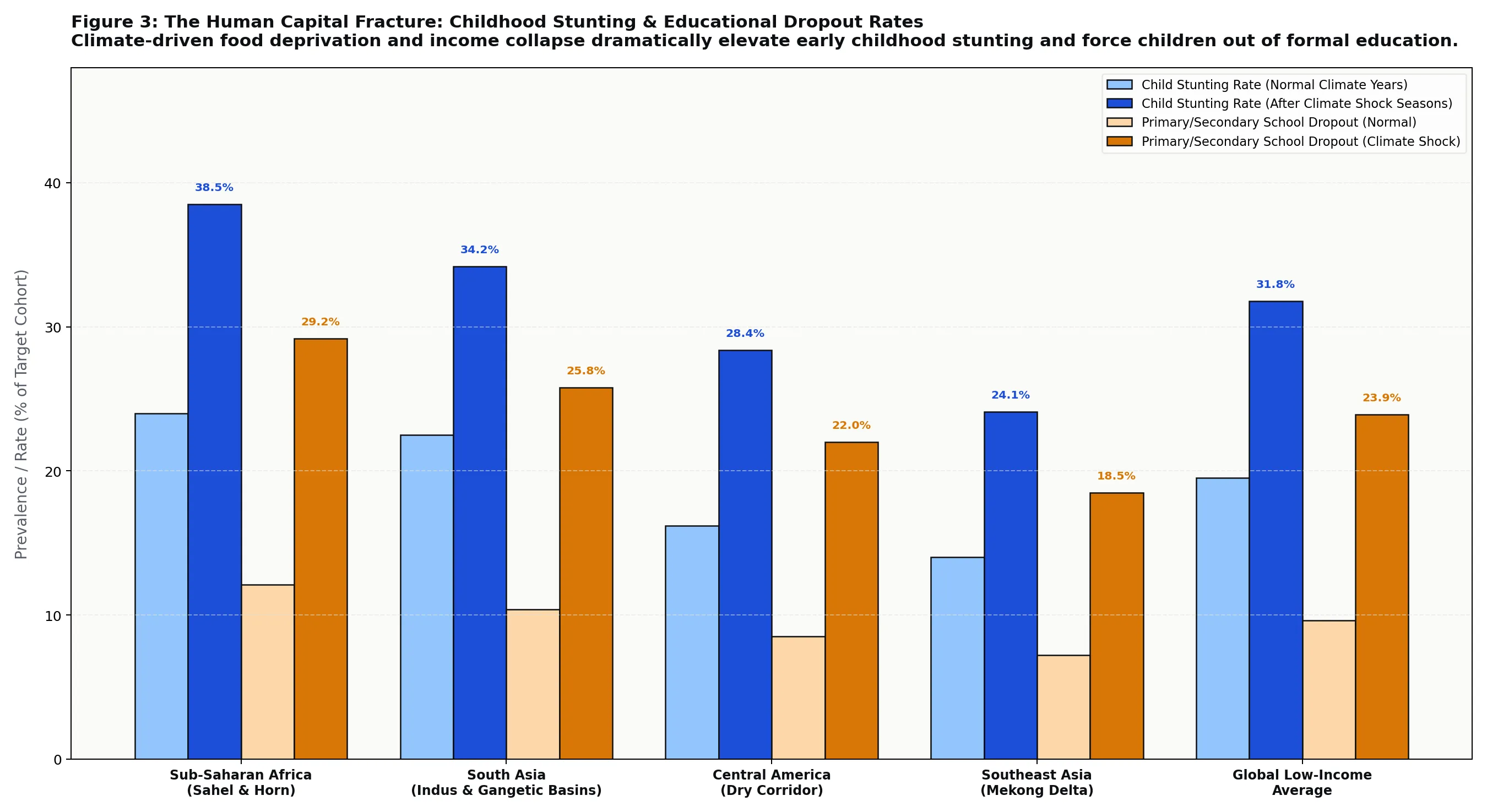
This nutritional austerity has catastrophic consequences during the critical “first 1,000 days” of life—from conception to a child’s second birthday:
- Irreversible Cognitive & Physical Stunting: Severe micro- and macronutrient deficits during this developmental window impair neural synapse formation and skeletal growth. Children who experience severe stunting suffer permanent reductions in adult IQ (5 to 11 points), reduced muscle mass, and higher lifetime vulnerability to metabolic diseases. Epidemiological data indicates that childhood stunting slashes adult earning capacity by 22% to 26%, permanently handicapping the national workforce.
- Stolen Schooling as a Survival Mechanism: When rural incomes plummet, education is often the first discretionary expenditure eliminated. Parents can no longer afford school uniforms, books, exam registration fees, or bus transit. Concurrently, children are pressed into economic activity: boys are sent to work as day laborers, farmhands, or street vendors, while girls are assigned to walk hours each day searching for scarce water and firewood.
- Gendered Harm & Early Marriage: In drought-stricken pastoral communities across the Horn of Africa and the Sahel, child marriage surges during extreme climate stress. Families marry off adolescent daughters to reduce the number of mouths to feed and to secure livestock bride-prices, truncating girls’ secondary education and perpetuating cycles of maternal mortality and poverty.
A child pulled from school for a single year rarely returns. The World Bank estimates that each lost year of primary and secondary schooling reduces an individual’s future lifetime earnings by 8% to 10%, translating into hundreds of billions of dollars in lost macroeconomic output across the Global South.
Chapter 4: The Displacement Domino: Distressed Migration and Urban Slum Strain
When crop failures become chronic and local water tables drop below viable extraction depths, rural communities exhaust their in-situ adaptation options. At that inflection point, mobility shifts from being a proactive economic opportunity to an act of desperate survival—a process known as distress migration.
Unlike affluent populations who can relocate into climate-resilient suburbs, impoverished agricultural laborers and pastoralists are forced to abandon their ancestral villages with few financial resources.
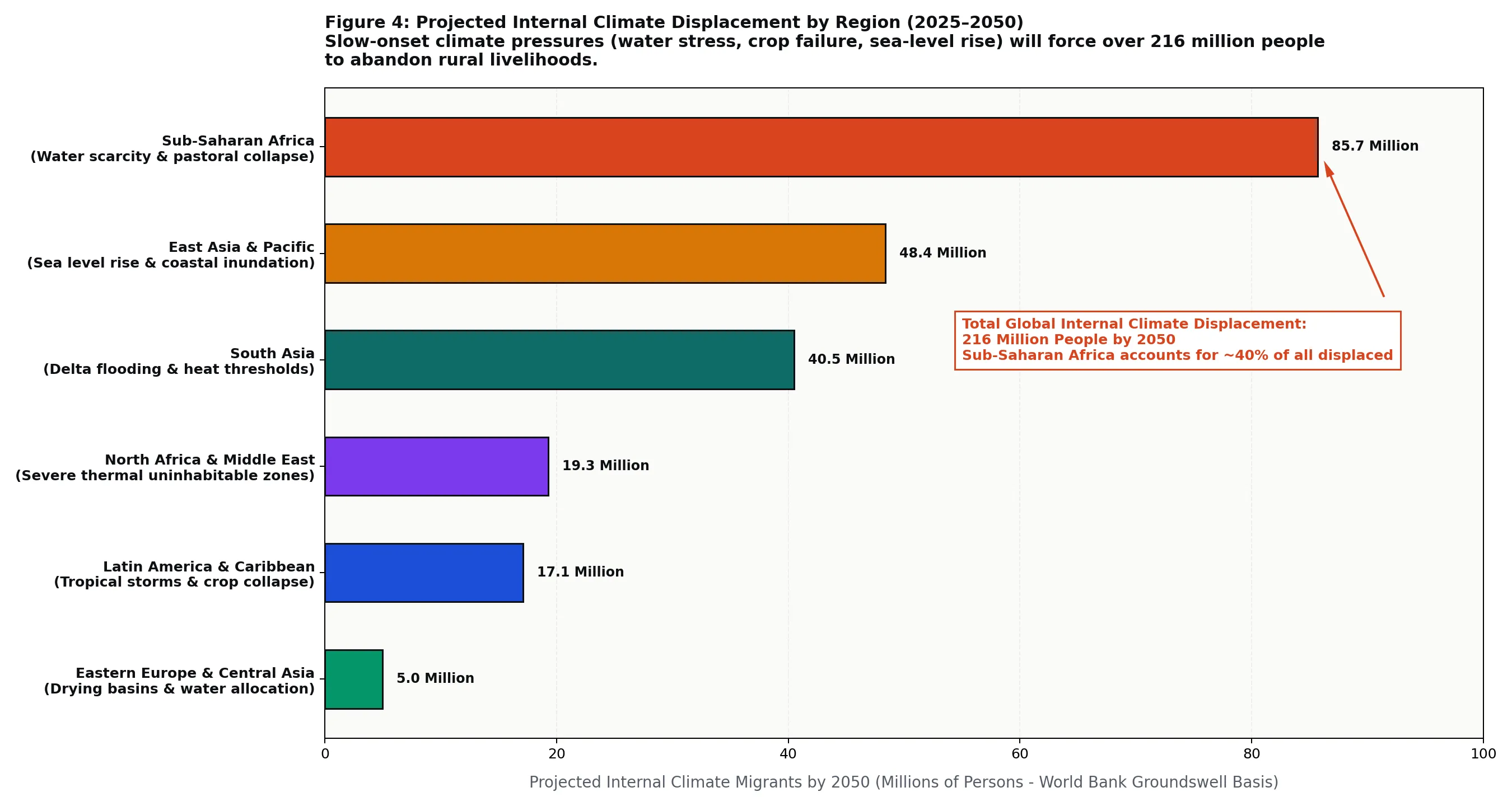
The displacement domino produces profound socio-spatial crises:
- The Urban Slum Sink: Most climate migrants do not cross international borders; they move to the nearest regional towns or megacities (e.g., Dhaka, Lagos, Karachi, Lima). These municipal centers are already struggling with severe infrastructure deficits. Migrants arrive in informal, unauthorized settlements built on precarious terrain—steep hillsides prone to landslides or low-lying swamps vulnerable to tidal flooding.
- Infrastructure Saturation & Public Health Traps: Influxes of rural migrants rapidly overwhelm municipal water delivery, electrical grids, wastewater treatment, and hospital clinics. Without piped sanitation, informal settlements become incubators for waterborne epidemics (cholera, typhoid, hepatitis E) and mosquito-borne vector diseases (dengue, malaria), creating compounding health burdens for the urban poor.
- Labor Market Glut & Informal Exploitation: Arriving without formal credentials or modern urban job skills, climate migrants enter saturated informal economies: day construction, scrap salvage, domestic service, and informal transit. This surplus labor supply depresses baseline wages across metropolitan areas, generating friction with existing working-class urban residents.
While sudden disasters like typhoons generate rapid, visible evacuations, slow-onset climate degradation (salinization of rice paddies, desertification, and groundwater depletion) produces the largest volume of permanent human displacement. Because slow-onset migration occurs gradually over years, it is frequently misclassified as voluntary economic migration, denying displaced people humanitarian aid and legal protection.
Chapter 5: From Resource Scarcity to State Fragility: Conflict in the Polycrisis
Climate change does not trigger warfare or civil conflict in a mechanical, deterministic vacuum. Rather, defense analysts, sociologists, and international relations scholars view climate volatility as the ultimate systemic threat multiplier: an environmental accelerant that interacts with pre-existing socio-economic inequalities, ethnic tensions, and corrupt governance to push fragile societies into violent breakdown.
When climate shocks simultaneously shrink the economic pie (agricultural contraction), raise the cost of basic survival (agflation), and displace large populations into neighboring ethnic territories, institutional trust evaporates.
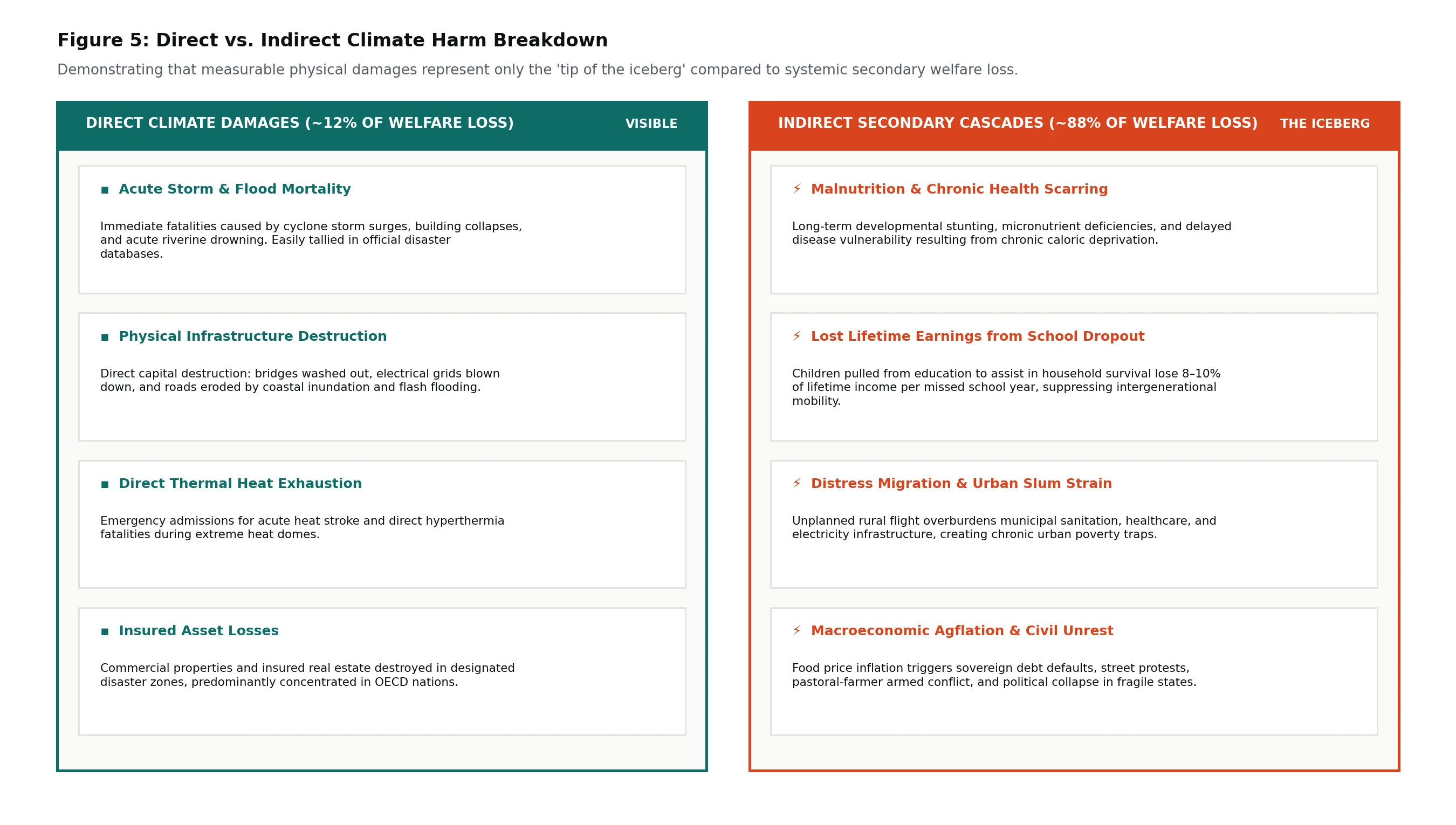
The table below delineates the profound structural disparities between visible direct climate impacts and the pervasive, indirect cascades that destabilize societies:
| Dimension | Direct Climate Impacts | Secondary & Tertiary Cascades |
|---|---|---|
| Primary Mechanism | Kinetic and thermal energy release (wind, storm surge, extreme ambient heat). | Systemic propagation across food systems, balance sheets, human capital, and social cohesion. |
| Time Horizon | Acute: hours, days, to weeks. | Chronic & Intergenerational: months, years, and decades. |
| Measurement Ease | High: satellite imagery, disaster declarations, emergency body counts, insurance claims. | Low: diffuse macroeconomic drags, chronic stunting, informal labor entry, social friction. |
| Share of Welfare Harm | Estimated ~10% to 15% of total societal damage. | Estimated ~85% to 90% of total societal damage. |
| Primary Victims | Property owners in hazardous zones, exposed outdoor workers, coastal dwellers. | Infants, pregnant mothers, rural smallholders, school-age children, informal slum dwellers. |
| Institutional Vulnerability | Physical infrastructure (bridges, sea walls, power stations, roadways). | Social safety nets, fiscal solvency, schools, healthcare systems, and democratic governance. |
| Conflict Potential | Localized looting and emergency coordination disputes during disaster response. | Armed farmer-herder clashes, food riots, cross-border militarization, and civil war. |
Empirical Case Studies of the Cascading Spiral
The cascading transmission from climate stress to political destabilization is not a theoretical projection; it has played out across multiple geopolitical arenas:
- The Sahelian Farmer-Herder Friction: In Mali, Burkina Faso, and Niger, advancing desertification and variable rainfall pushed Fulani pastoralists southward into lands traditionally cultivated by sedentary Dogon and Bambara agriculturalists. As water holes and grazing lands dwindled, disputes over crop trampling transformed into heavily armed communal militias, contributing to widespread state collapse, military coups, and extremist insurgencies across the Sahel.
- The Syrian Pre-War Drought (2006–2011): The Fertile Crescent experienced the most severe multi-year drought in modern instrumental history, wiping out 80% of livestock in northeastern Syria and forcing an estimated 1.5 million rural citizens into the urban peripheries of Damascus, Aleppo, and Homs. The resulting youth unemployment, water shortages, and steep food prices created a combustible socio-economic climate that ignited the 2011 civil uprising.
- The Sri Lankan and East African Debt-Agflation Crises: In 2022–2026, compounding climate shocks combined with imported food and fuel price inflation to destroy foreign exchange reserves, sparking mass street demonstrations, the storming of government palaces, and sovereign debt defaults.
Strategic Priorities for Policy and Climate Adaptation
To mitigate the catastrophic secondary effects of climate change, the international community and national governments must pivot from disaster-response charity toward structural systemic resilience:
- Anticipatory Cash Transfers & Shock-Responsive Social Safety Nets: Governments must link social protection registries to predictive satellite meteorological forecasts. When severe drought or flood conditions are detected before harvest failure occurs, automated mobile cash transfers should be disbursed to vulnerable households, preventing the liquidation of productive assets and keeping children in school.
- Universal School Feeding Programs: School meals provide a powerful counter-cyclical safety net. By guaranteeing at least one nutritious meal per day at school, governments protect child caloric intake while creating an irresistible financial incentive for impoverished parents to keep both boys and girls enrolled during climate crises.
- Climate-Resilient Debt Clauses (CRDCs): International financial institutions (World Bank, IMF, regional development banks) must mandate that sovereign bonds for climate-vulnerable nations automatically pause debt-service payments following certified climate disasters. Freeing up fiscal capital during crises ensures governments can subsidize staple food imports and prevent agflation riots.
- Targeted Investment in Rural Water Security & Decentralized Storage: Developing farm-level rainwater harvesting, sand dams, drip irrigation, and solar-powered groundwater pumps reduces agriculture’s vulnerability to rainfall volatility, preventing the initial crop collapse that sets the cascading domino in motion.
Direct climate damages may capture television headlines, but it is the invisible, secondary cascades—stunted children, abandoned schools, overwhelmed urban slums, and fractured states—that will define the true human cost of the climate polycrisis. Addressing these cascades is no longer merely an environmental concern; it is the fundamental prerequisite for 21st-century human survival and global security.
References
- [1] Intergovernmental Panel on Climate Change (IPCC). Climate Change 2022: Impacts, Adaptation and Vulnerability. Contribution of Working Group II to the Sixth Assessment Report. Cambridge University Press, 2022. doi:10.1017/9781009325844.
- [2] Clement, V., Rigaud, K. K., de Sherbinin, A., et al. Groundswell Part 2: Acting on Internal Climate Migration. World Bank, Washington, DC, 2021. doi:10.1596/36445.
- [3] Carleton, T. A., & Hsiang, S. M. Social and economic impacts of climate. Science, 353(6304), aad9837, 2016. doi:10.1126/science.aad9837.
- [4] Food and Agriculture Organization (FAO), IFAD, UNICEF, WFP, & WHO. The State of Food Security and Nutrition in the World 2024: Financing to end hunger, food insecurity and malnutrition in all its forms. FAO, Rome, 2024. doi:10.4060/cd1254en.
- [5] Romanello, M., Napoli, C. D., Green, C., et al. The 2023 report of the Lancet Countdown on health and climate change: The imperative for a health-centred response in a world facing irreversible harms. The Lancet, 402(10419), 2346–2394, 2023. doi:10.1016/S0140-6736(23)01859-4.
- [6] Burke, M., Hsiang, S. M., & Miguel, E. Global non-linear effect of temperature on economic production. Nature, 527(7577), 235–239, 2015. doi:10.1038/nature15725.
- [7] Victora, C. G., Adair, L., Fall, C., et al. Maternal and child undernutrition: Consequences for adult health and human capital. The Lancet, 371(9609), 340–357, 2008. doi:10.1016/S0140-6736(07)61692-4.
- [8] Psacharopoulos, G., & Patrinos, H. A. Returns to investment in education: A decennial review of the global literature. Education Economics, 26(5), 445–458, 2018. doi:10.1080/09645292.2018.1484426.
- [9] Kelley, C. P., Mohtadi, S., Cane, M. A., et al. Climate change in the Fertile Crescent and implications of the recent Syrian drought. Proceedings of the National Academy of Sciences, 112(11), 3241–3246, 2015. doi:10.1073/pnas.1421533112.
- [10] Mach, K. J., Kraan, C. M., Adger, W. N., et al. Climate as a risk factor for armed conflict. Nature, 571(7764), 193–197, 2019. doi:10.1038/s41586-019-1300-6.
- [11] Hsiang, S. M., Burke, M., & Miguel, E. Quantifying the influence of climate on human conflict. Science, 341(6151), 1235367, 2013. doi:10.1126/science.1235367.
- [12] Stern, N. The Economics of Climate Change: The Stern Review. Cambridge University Press, 2007. doi:10.1017/CBO9780511817434.
- [13] Hallegatte, S., Vogt-Schilb, A., Bangalore, M., & Rozenberg, J. Unbreakable: Building the Resilience of the Poor in the Face of Natural Disasters. World Bank, Washington, DC, 2017. doi:10.1596/978-1-4648-1003-9.
- [14] International Monetary Fund (IMF). Fiscal Monitor: Climate Change and Vulnerability in Developing Economies. International Monetary Fund, Washington, DC, 2024.
- [15] United Nations Children's Fund (UNICEF). The Cold Truth: The Climate Crisis Is a Child Rights Crisis. UNICEF, New York, 2023.
Topics
Keywords
secondary effects of climate change · climate cascade · food price inflation · climate migration · educational disruption · malnutrition · political instability · polycrisis · indirect climate damages · human capital destruction
Published open access under CC BY 4.0. © 2026 H Heuristics.
How to cite
APA
Hughes, H. (2026). The Secondary Effects of Climate Change: Cascading Shocks from Extreme Weather to Food Insecurity, Educational Disruption, Migration, and Political Instability (Report No. HX-2026-007). H Heuristics. https://projects.hheuristics.com/reports/the-secondary-effects-of-climate-change/
BibTeX
@techreport{hughes2026thesecondary,
  author      = {Hunter Hughes},
  title       = {{The Secondary Effects of Climate Change: Cascading Shocks from Extreme Weather to Food Insecurity, Educational Disruption, Migration, and Political Instability}},
  institution = {H Heuristics},
  number      = {HX-2026-007},
  type        = {Report},
  year        = {2026},
  url         = {https://projects.hheuristics.com/reports/the-secondary-effects-of-climate-change/},
  note        = {Open access, CC BY 4.0}
}